Wednesday, August 1, 2012
Uganda Mission 2012
Sunday, July 1, 2012
Anxious Thoughts
Saturday, June 2, 2012
Balancing Act
Tuesday, April 24, 2012
Lazarus Applications
Tuesday, March 6, 2012
"Passive Righteousness" -- Martin Luther

Commentary on Epistle to the Galatians, Preface—Martin Luther, 1535
It is necessary to teach continually this doctrine of the righteousness of faith, lest Satan bring the church once again into the doctrine of works and people’s traditions. Because of enormous pressures that face us from every side—from Satan, our sinful nature, and numerous other temptations—this doctrine can never be taught and impressed on us enough. On the one hand, if this doctrine be lost, then everything is lost—truth, life, and salvation. On the other hand, where this doctrine is loved, then all good things flourish—genuine love for God, the glory of God, and the knowledge of all things necessary for Christian living.
The beauty of passive righteousness. There are many types of righteousness in this world. However, the greatest type of righteousness is the righteousness of faith or passive righteousness, which God through Christ gives to us, without our doing a thing. This wonderful righteousness is not political, ceremonial, or cultural righteousness. Neither does it have anything to do with our obedience to God’s law. It has nothing to do with that we do or how hard we work. It is simply given to us as a gift, and we do nothing for it. Thus, it is called, “passive righteousness” because we do not have to labor for it. It is called the righteousness of faith because it is not righteousness that we work for, but righteousness we receive by faith.
This passive righteousness is a mystery that someone who does not know Jesus cannot understand. In fact, Christians do not completely understand it and rarely take advantage of it in their daily lives. So we have to constantly teach it over and over again to others and repeat it to ourselves, because if we do not understand and have it in our hearts, we will be defeated by our enemy and become ineffective and discouraged.
Passive righteousness is the great comfort of the conscience and peace for the soul. For example, when we clearly see the law of God, we quickly see our sin. The evil in our lives comes to mind, it tears us apart, and we groan, “I cannot believe that I did that again. Lord, I promise I will not do that again.” For when we are in trouble or our conscience bothers us, the devil likes to make us afraid by using the law, and he tries to lay on us the guilt of sin, our wicked past, the wrath and judgment of God, and eternal death to drive us to desperation, make us slaves to him and pluck us from Christ. Furthermore, he wants to set against us the parts of the gospel where Christ requires good deeds from us and with plain words threaten damnation to us if we do not do them.
This troubled conscience has no cure for desperation unless it takes hold of passive righteousness. So, when I see a person who is bruised and oppressed by the law, terrified of sin, and thirsting for relief, it is time to take the law and active righteousness out of his sight and show him the gospel of passive righteousness which offers the promise of Christ, that he came for the suffering and sinners. Then this person is raised up and has renewed hope, now that she is no longer under law but under the gospel of grace.
Therefore, when there is fear or our conscience is bothered, it is a sign that our “passive” righteousness is out of sight and Christ is hidden. But when we truly see Christ, we have full and perfect joy and peace in the Lord, and we certainly think: “Although I am a sinner by the law, I do not despair. I do not die because Christ lives, who is both my righteousness and my everlasting life. Although I am a sinner in this life of mine as a child of Adam, I have another life, another righteousness above this life, which is in Christ.”
How do we obtain this righteousness? So do we do nothing? Do we not do any work to obtain this righteousness? I answer nothing at all. It is like this: the earth does not produce rain, nor it is able by its own power or work to get it. The earth simply receives it as a gift of God from above. It is the same with “passive” righteousness. It is given to us by God without our deserving it or working for it. So look at what the earth is able to do to get the rain each season so that it can be fruitful, and we will see how much we are able to in our own strength and works to do to get heavenly and eternal righteousness. We see we will never be able to attain it unless God himself, by the great gift of his Son, gives us Jesus’ perfect record, and gives us Jesus’ perfect righteousness. Thereby, as we have borne the image of the earthly Adam, we shall bear the image of heavenly Adam. We shall be new people in a new world, where there is no law, no sin, no remorse, or sting of conscience, no death, but perfect joy, righteousness, grace, peace, salvation, and glory.
The obedience that flows from passive righteousness. Paul diligently sets out in this letter to teach us, to comfort us, and to keep us constantly aware of this great Christian righteousness. For if the truth of our being justified by Christ alone is lose, then all Christian truths are lost. There is no middle ground between “passive” and “works” righteousness. The person who wanders away from “passive” righteousness has no other choice but live by “works” righteousness. If he does not depend on the work of Christ, he must depend on his own work. So we must teach and continually repeat the truth of this “passive” or “Christian” righteousness so that Christians continue to hold to it and never confuse it with “works” righteousness. On this truth, the church is built and has its being.
Now, when I have this righteousness reigning in my heart, I descend from heaven like rain making the earth fruitful, that is to say, I enter into new kingdom and I do “good works” whenever and however I get the opportunity. In conclusion, whoever is convicted that Christ is his only righteousness, does not only do his work cheerfully, gladly and well, but also, if necessary, submits to all kinds of burdens and sufferings in this life with love because he knows this is God’s will, and that God is pleased by his obedience.
Thursday, January 19, 2012
Inspiration

The Lord GOD has given Me the tongue of disciples, that I may know how to sustain the weary one with a word. He awakens Me morning by morning, He awakens My ear to listen as a disciple (Isaiah 50:4).
Sadly, but probably characteristically to all people who are in positions involved in large doses of outward-going communication, personal inspiration is often in short supply. Preachers and teachers and coaches and mentors and authors, after all, are typically those who inspire and catalyze and maximize and launch and equip others into larger and grander and deeper and richer and more cultivated spheres of life. To ask those who are normally the dispensers of inspiration how and when and where and why and from whom they seek personal inspiration is rather alien. I know it is for me. I am rarely inspired, which is odd because I seek to inspire others nearly constantly in line with the admonition in Hebrews 10:24—“Let us consider how to stimulate others to love and good deeds.”
Nevertheless, I have been inspired this New Year. But let me be clear, this inspiration did not come as a result of “turning over a new leaf” or a resolution. I have been uncooperatively inspired by providential barrage and sheer repetition. From three different angles in as many weeks this New Year the Lord has seen fit to press certain preacher/teacher/author in front of my face. I caved and found, by default, personal inspiration.
To illustrate the degree to which I was reluctant, but am now enthusiastic, about this unsought-after soul-nourishment consider when and where I am typing madly away at my keyboard. I am blogging this article before I have totally finished sweating from my jog, on one of my few coveted weekday evenings without a meeting. Having given that preface, I have just listened to perhaps the best sermon I have heard in years—on Jacob and Leah called "The Struggle for Love" (Genesis 29)—and “sermon” is my primary language these days. That’s funny because I gave a similar endorsement of another sermon by the same bloke just a few days ago. And that’s funny because I had a similar conversation where this preacher came up with glowing accolades just a few days before that. I hesitate to mention his name outright because I really don’t think it is so much that this man is the most remarkable factor in my recent “dry season” regarding personal inspiration—although he is a true pro (Dr. Timothy Keller, Redeemer Presbyterian Church, New York City)—because I am convinced that the Lord Himself has “awaken[ed] my ear to listen as a disciple” (Isaiah 50:4) more than the man.
I balk at the pattern in which I have been skulking (perhaps for a couple of years?!?), attempting in ministry to “sustain the weary one with a word,” yet without maintaining a posture of a learner; without a reservoir of personal inspiration.
As is always the case, Jesus is better. Our Lord is simultaneously the supremely better teacher and the supremely better disciple, held in powerful balance. By application, being a disciple not only is the beginning of effective disciple making, it is a resultant by-product as well. It is a “morning by morning” process of giving out and receiving in … and it sounds like ministry health.
Check out these free sermons (mp3 format) at www.sermons.redeemer.com or on iTunes under Timothy Keller Podcasts:
“The Struggle for Love,” Genesis 29:15-35, November 11, 2001 #RS 141-3
“The Prodigal Sons,” Luke 15:1-2, 11-32, September 11, 2005 #RS 187-01
“The Wounded Spirit,” Proverbs 12:25 and various others, December 5, 2005, #RS 178-13
“The Cosmic King,” Revelation 1:9-18, May 23, 1993, #RS 41-02
Wednesday, December 21, 2011
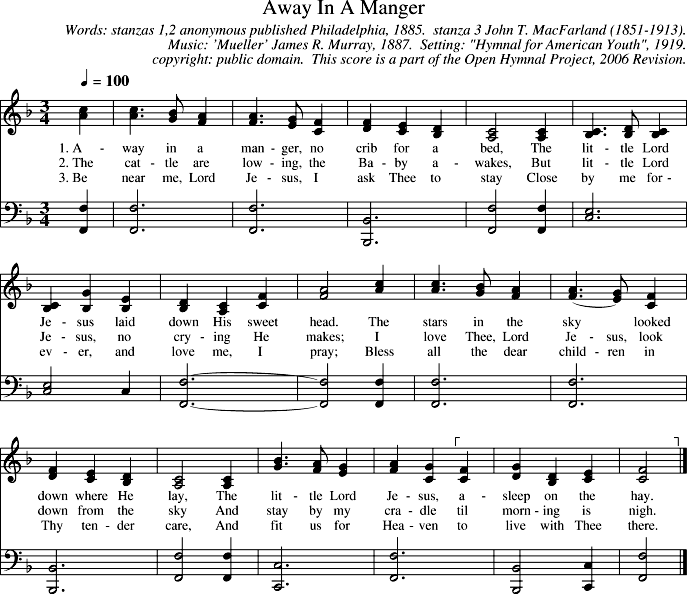
Away in a Manger

THE CATTLE ARE LOWING, the Baby awakes. But little Lord Jesus no crying He makes. Wait a second! That line in the second verse of the beloved carol, “Away in a Manger,” has irked me for years. Of course, it has not been enough to stop me from singing it at Christmas Eve services or at times of caroling around the piano or even at bedtimes with the children (during, potentially, any month of the year, not just December!). But the pebble of irritation about the manger scene has proven to be just enough to re-open the Christmas narrative and see if such a detail is explicitly mentioned or implicitly inferred anywhere. Did little Lord Jesus, really, no crying make?
Verdict—Mary’s first delivery was a normal, healthy delivery in every way, which leads me to conclude that there must have been plenty of crying to go around! Jesus, Mary, Joseph, shepherds, and eventually the wise men—pass the Kleenex® box around. Can angels cry? Well, if they can they too might have joyfully blubbered with the rest of them! “I bring you good news of great joy which will be for all the people” (Luke 2:10).
Not in 2011 … nor, for the record, in 2012(!) … but Shellie and I have made our rounds through the obstetrics ward at the hospital five wonderful times in the last 14¾ years. We have concurred that it would not be in the least bit serene, or happy, or joyful to have a baby who was not crying in the first moments of life. There is nothing in the Christmas account in Scripture that even remotely suggests that Mary’s delivery was any different than any other woman’s delivery or that Jesus’ birth was anything different than any other baby’s birth. Certainly, Mary and Jesus were unique in ways that beg for more study and more dialogue, but the events of that night were entirely … and dare I say … blessedly ordinary.
I am not trying to spar with poetic license written into “Away in a Manger.” Actually and tangentially, I found something else noteworthy in the relatively few verses allotted to Jesus’ birth in the Bible; something that I might have missed if it were not for my borderline compulsive urge to fact-check traditional Christmas carols. This year I noticed an amazing absence of anything out of the ordinary with Jesus’ actual birthday. His birth infused blessing into uneventfulness.
Perhaps you are like us in this regard, too often we give thanks for the brushes with the supernatural; those macro- or micro-deliverances that could only be explained after-the-fact by a providentially attentive Almighty God who graciously scrutinizes our paths. But I don’t know if I have ever before thought of the blessing of the ordinary. Granted, on that first Christmas there are many elements of sheer drama and utter terror, where the so-called experts were tongue-tied and the so-called bumpkins were silver-tongued. We would be the last to remove, even remotely, the supernatural from the Incarnation. But on that night, with that couple, in that stall, with that feeding trough nothing extraordinary happened. On the nearby hillside where the shepherds were guarding their flocks at night, there were supernatural fireworks going off. In the far-away sand where the Magi were studying the night-sky, there were miraculous “dots” being connected. But in the stable behind the inn which had no room for the King-in-disguise there was the blessing of uneventfulness.
Mary, for sure, had unanesthetized labor-pains throughout her delivery. Joseph, for sure, wished there was someone else present who had actually delivered a baby before; or at least someone who could advise him about basic female anatomy since he and Mary had not seen each other in that way yet. Not to belabor the point (pun intended!), but there was blood and fluid and after-birth and the ubiquitous clumsiness of figuring out how to feed a baby as a first-time mom. And, in my imagination, crying must have been generously exercised—before, during, and after the birth.
For Mary and Joseph all the miracles—and there were many—happened before and then after this very ordinary birth. The conception, of course, was perhaps the greatest miracle of all. The marriage that was not severed when Joseph discovered the news of Mary’s pregnancy without his (or any male’s) participation—this was a miracle that must not slip past our careful attention. Mary’s miraculous welcome received from her relative, Elizabeth, who was also miraculously pregnant. Jesus’ fantastic in utero greeting from his in utero cousin, John (the Baptist), was also miraculous. Time prevents a full treatment of the miracles that light up the narrative: the shepherds, the angels, the Christmas Star that apparently moved as needed to guide the wise men to Jesus, the escape from the massacre at Bethlehem, the dreams given to Joseph several times along the way, the name selected for the Savior, the city where the birth took place, even the timing of the tax requirement issued by Quirinius the Roman governor of Palestine at the time.
But that night, away in a manger, God steeped sublime dignity into the ordinary by allowing His Son to be birthed in exactly the same way all humans are birthed. God infused supernatural guidance and perseverance—incognito—into the otherwise uneventfulness of Christmas. This is the Christmas meditation that I stumbled across while looking for another thing altogether—what so often feels like God’s distance when it takes our every ounce of energy just to keep “treading water” in the ordinary, just trying to make it, just waiting for the time to punch out for the weekend … what often seems like God’s disinterest or even disapproval in our achingly long stretches of silence and uneventfulness … might actually be the times when God is nearest of all. God is not always found in the euphoria of the phenomenal, or in the serenity of the mystical. Sometimes—and arguably most times—God is found in the ordinary manger straw that is intentionally hidden in the alley behind the neon “no vacancy” sign, underneath the pain, awash with salty tears on the clumsy side of life when we think no one is paying any attention at all. Pass the Kleenex® box—for what seems to be the most ordinary may be, in fact, our front row seat for the most extraordinary thing of all: God came near.