Sunday, July 1, 2012

Anxious Thoughts

There are disquieting, if not downright dangerous, prayers that spiritual giants have prayed. 
Jacob prayed, “Please tell me Your name” (Genesis 32:29).  The answer shook his identity.
Moses prayed, “I pray, show me Your glory” (Exodus 33:18).  The answer shook the mountains.
Hannah prayed, “Give Your maidservant a son, then I will give him to the LORD all the days of his life” (1 Samuel 1:11).  The answer shook up the entire ministry.
Elisha prayed, “O Lord, I pray, open his eyes that he may see” (2 Kings 6:17).  The answer shook loose the division between the spiritual and visible realms.
Hezekiah prayed, “Now, O LORD our God, I pray, deliver us from his hand that all the kingdoms of the earth may know that You alone, O LORD, are God” (2 Kings 19:19).  The answer shook to oblivion the day’s world power preparing to besiege Jerusalem.
Paul prayed, “Who are You, Lord? …. What shall I do, Lord?” (Acts 22:8,10).  The answers shook open the Roman Empire to the gospel of the grace.
Jesus prayed, “Your kingdom come. Your will be done; on earth as it is in heaven” (Matthew 6:10) ... “My Father, if it is possible, let this cup pass from Me; yet not as I will, but as You will” (Matthew 26:39) … “Father, forgive them for they do not know what they are doing” (Luke 23:34).  The answers shook apart and mended together again heaven and earth, time and space, life and death.
Recently, I was prompted to pray a disquieting / dangerous prayer originally prayed by David—“Search me, O God, and know my heart.  Try me and know my anxious thoughts and see if there be any hurtful way in me, and lead me in the everlasting way” (Psalm 139:23-24).  The answer has mercifully shaken me. 
I have already known that I have “anxious thoughts.”  Before even I knew the gospel, I knew this.  But since praying this prayer my anxieties have been exposed; pulled into the light … yet not without a fight.  My anxiety is as natural to me as breathing and so my flesh wants to protect it, justify it, and feed it.  So much so that it seems somehow “off” not to have something weighing on my mind.  What shook me, though, is why I return back to anxiety instead of run to the cross; for with every idol there is some kickback … some counterfeit promise … some reason we keep going back. 
Anxiety, it occurred to me as I prayed, has surprisingly two “draws” upon my flesh: my attempt to lessen my guilt and my attempt to gain some credit.  Some people’s flesh pattern (a biblical term for our way of living, coping, surviving that is yet quite apart from Christ) is to blame others and assume no or little responsibility for sin while others’ pattern is to blame self and assume a lot or all responsibility for sin.  I blame myself more times than not.  Since I blame myself, I am nearly always carrying a weight of guilt—real or imagined.  “It is my fault.  Even if it is not my fault; it might be my fault from some angle I hadn’t even considered … and I am, therefore, answerable to God.” 
So along with guilt, there is fear; fear that I am displeasing to God.  Enter anxiety!  Without even realizing it, and sometimes even proudly, I run to anxiety to deal with my fear and guilt in an attempt to minimize my guilt before God.  If I can just stay a few steps ahead of the game, a few strides ahead of the curve, a few moves ahead of the opponent, then I can minimize guilt.  What’s more is that I find myself rationalizing this pattern—“Well, at least I care … No one else in the universe cares about this particular issue except me … If I am not on my “game” then something seriously wrong might happen—something for which I might be responsible and answerable to God.”  Anxiety, then, is part of the strategy.  I can appeal to my attempts to be well prepared.  I can appeal to my solitary crusade to care about something important.  I can say, “Well, at least I tried” and hopefully get some of the credit for being a responsible, moral person.  Yuck!  Twisted!  Evil!  Anti-christian!  Shaken!
The Savior forgives sin and satisfies guilt—not my staying a few steps ahead of the game.  The Savior swallows up sin, even the sins about which I am not aware—not my over-zealous sense of responsibility.  The Savior loves and His loves casts out fear—not my anxiety.  The Savior did the work of salvation and sanctification—not His work plus my self-righteous “help.”  The Savior answers to God on my behalf since I have deferred my destiny into His capable advocacy—not my clever appeals that attempt to make me look better than I really am and make God’s holy demands less than they really are.
Anxiety is a control technique that I revert to when I disbelieve the gospel is sufficient, when I disbelieve the Savior is good, when I disbelieve that God is all-powerful.  I seek my own "Plan B" to minimize guilt and to lay some claim on the credit for navigating life just a little bit better than others.
Wow.  I wasn’t planning on any of that.  I was just praying, “Search me, O God, and know my heart.  Try me and know my anxious thoughts and see if there be any hurtful way in me, and lead me in the everlasting way” (Psalm 139:23-24).  It turned out to be a downright dangerous prayer to pray.  “God, be merciful to me, the sinner” (Luke 18:13).

Saturday, June 2, 2012

Balancing Act

Balancing Act - Ten years ago and just yesterday I had the same sort of conversation with two of my children regarding balance and riding a two-wheeler while my mind was fully engaged with the upcoming sermon text.  (It is funny [and eerie] how normal conversations mix with Bible passages in my brain each week.  Object lessons are everywhere when Scripture is cooking in the back of the brain.)

Imagine the scene: We took off the training wheels, went to the blacktop at the school, strapped on the helmet, the knee and elbow pads, and looked at 200 feet of asphalt that spread out before us.

“I can’t do this. I am going to fall.”
“You can do this. You’ve learned everything you need to know. Yes, you still might fall, but I will be right here with you,” I reassured.
“How do I stay up?”
“You stay up by moving forward.” I coached.
“How do I move forward?”
“You move forward by staying up. Keep your balance and keep pedaling.” I answered.
“What if I start to fall?”
“Just relax and keep pedaling straight ahead. Don’t look at your feet, or your tires, or even me; just look straight ahead at where you want to go,” I explained.  "Where your eyes look is where you will go."

I could see the problem: both of my children, spaced almost ten years apart, have to move forward in order to stay upright, and in order to stay upright they have to move forward.  Have you ever noticed that bicycles are unusual in that sense?  By themselves and stationary, bikes are clumsy—unable to even stand up without help.  But with a confident rider and with steady motion, bikes are sleek, remarkably stable, and precise.  It is amazing, even with the whirr of motion and beads of sweat, bicycling is ironically restful and refreshing.  But not for novices on two-wheelers without the training wheels … not yet at least.  Even though he got the hang of it on a two-wheeler that afternoon ten years ago, and even though she will soon get the hang of it in a matter of days, the conversation is the same.  "Where your eyes look is where you will go."

Our balance on the bicycle applies to our balance on the journey of the heart.  How do we keep our balance?  By moving forward.  How do we move forward?  By keeping our balance.  What if we start to fall?  From a position of rest in Christ, we actively pedal while trusting His power to pedal through us.  We must not focus on the blur of activity all around us; instead we must focus on our goal—which again is Christ.  He is our starting block and our finish line, our path and our strength while on the path.  He is our source, our means, and our goal.

Tuesday, April 24, 2012

Lazarus Applications

(1) I earnestly desire for us to realize how, in our natural state, we are in the same predicament as Lazarus.  We are dead.  There is nothing Lazarus could do to please God there in the tomb.  There is nothing Lazarus could have given to the poor.  There is nothing that Lazarus could have offered to advance the Kingdom of God.  We are Lazarus … just before the Savior speaks him to life.  There is nothing we can do or say to God.  In the part of us that really counts, where we relate to God, we were lost, sick, dead, and separated.  But Jesus came to us—to our tomb—and spoke us into life; born again.  If we have not been born again—still in our tomb—Jesus is on His way to where we lie.  He speaks and the elect come to life.  Perhaps this day—Resurrection Day—is the day you hear the Savior’s voice and stir to life, and turn to your neighbor’s to help you shed your grave clothes.  You cannot do it on your own.  Only Jesus can do it for you; and He is willing.  Will you hear His voice today and emerge from your tomb?

(2) I earnestly desire that we realize that there are many kinds of death and Jesus is Lord of all of them.  The dissolved or dissolving marriage.  The dead or dying dream.  The crippling thought (and then behavior pattern) that leads to greater and greater degrees of bondage.  The deteriorating physical body.  The dead-end career.  The disappointment that is sometimes culled but never absent from your days.  The thorns and thistles creeping ever closer and closer to the center of the garden.  The loss of joy in life and perhaps even the will to live.  The darkness that grips your heart and whispers shame and condemnation.  The fear of death, loss, or rejection.  Whatever shape of death that fills each of your shadows and occupies every idle moment—Jesus is Lord of the dead. 
Jesus’ words of committal while hanging on the cross can give us the words of faith in all the in-between “death” places between the cradle and the grave—“‘Father into Your hands I commit My Spirit’ and having said this He breathed His last” (Luke 23:46).  “Father into Your hands, I commit ________.”  “Father into Your hands I commit my marriage, my pain, my dashed hopes, my future, my past, my present, my loneliness, my disappointment, my shame, my guilt, my embarrassment, my failure, my fear, my inability, my pride, my goodness, my wickedness, my sin, my sins, my death, my life, my kids, my parents, my mind, my body, my love.”  And having said this, we breathed our last—like Lazarus—and fall upon the mercy/grace of God.

(3) I earnest desire that we accept that not everyone in the cemetery was called out of his tomb that day in Bethany.  But this is not because Jesus was unable.  It is because Jesus only does what the Father wills.  Therefore, it is a point of maturing faith that says, like Jesus, I only want what the Father wills.  It does not mean we don’t ask, knock, and seek, but if the answer comes back as a “no” I want our trust in the Father’s will to be large enough to accept it as a veiled goodness that will produce more glory for God and more holiness for us.  I want us to have humility regarding the larger perspective to defer back to God’s goodness and wisdom.  Mature belief will not be idle or unprepared, but at the same time it will resist the temptation to scrutinize the Father’s will in unbelief. 
Instead of saying, “If You had been here, my brother would not have died”—which has sincere but limited faith—we will instead say, “You are here, and my brother died.  I don’t understand that, but I trust that You know better than I.  I cannot understand Your ways, but I rest in Your goodness.  Enable me to glorify Your great name even in this period of mourning and confusion; even without the answers to my curiosities … even without my brother.”

(4) I earnest desire to communicate that the gospel is not an embalming technique where we delay decay.  The gospel is not a sin management procedure where we contain and organize our less-desirable tendencies.  The gospel is not a reputation enhancement pep-talk where we improve ourselves and improve how others view us.  No!  Ten-thousand times no!  The gospel says—you are even worse than you thought, but Jesus is better even than you dreamed. 
You are even worse than you thought in that—like Lazarus—you are already past the point of no return, already decaying, already stinking.  You are unable to do anything in the realm of life, unable to reverse death or escape the curse, and certainly unable to please God.  You are dead spiritually.  Physically and emotionally we are still able to move and speak and decide things—so it is not like we can’t do things, but none of those things we try actually help our true situation.  So it is worse than Lazarus, really—at least he couldn’t make his situation worse!  We can and do make our situation worse when we try to live on our own terms and please God and others in our own “zombie-strength.”  But trying our own schemes we only increase our guilt by adding self-righteousness to our wickedness. 
We are even worse than we thought, but Jesus is better even than we ever dreamed.  He is not merely a good man, not merely a clever teacher, not merely a wise sage, not merely a miracle worker, not merely a historical figure.  He is not a “crutch” to psychologically weak people like Freud taught, not “the opiate of the masses” like Marx taught, not “dead” like Nietzsche taught, and not silent, nor irrelevant, nor antiquated like our culture teaches today.  He is not at all a band-aid® on our “ouchies,” not at all a “fire insurance policy,” not at all a social club where we make business deals in the parking lot.  Jesus is the Life who swallows up death by dying.  Jesus is the Resurrection who empties occupied tombs with a spoken word.  Jesus is the Bread who satisfies our deepest hunger.  Jesus is the Light who chases away the darkness.  But Jesus is more than metaphors—He is concrete as well.  He solves our sin problem by dying in our place.  He solves our death problem by raising us to life again and marching at the head of the parade of all who believe and follow Him.  He solves our prejudice problem by breaking down the dividing walls that the world taught us to build and protect.  He solves our significance problem by sending us out in His name on mission.  He solves our selfishness problem by setting us free from the power of sin.
But Jesus is more than the sum of all the descriptions we can compose about Him.  He is Lord of lords.  He is King of kings.  He is the one and only Mediator between God and man.  He is the only Way, the only Truth, the only Life.  He is the All in all.  He is risen.  He is here.   And He is saying to us just as He said to Martha, “Who[ever] believes in Me will live even if he dies, and everyone who lives and believes in Me will never die. Do you believe this?” (John 11:25-26).

Tuesday, March 6, 2012

"Passive Righteousness" -- Martin Luther


Commentary on Epistle to the Galatians, Preface—Martin Luther, 1535

It is necessary to teach continually this doctrine of the righteousness of faith, lest Satan bring the church once again into the doctrine of works and people’s traditions. Because of enormous pressures that face us from every side—from Satan, our sinful nature, and numerous other temptations—this doctrine can never be taught and impressed on us enough. On the one hand, if this doctrine be lost, then everything is lost—truth, life, and salvation. On the other hand, where this doctrine is loved, then all good things flourish—genuine love for God, the glory of God, and the knowledge of all things necessary for Christian living.

The beauty of passive righteousness. There are many types of righteousness in this world. However, the greatest type of righteousness is the righteousness of faith or passive righteousness, which God through Christ gives to us, without our doing a thing. This wonderful righteousness is not political, ceremonial, or cultural righteousness. Neither does it have anything to do with our obedience to God’s law. It has nothing to do with that we do or how hard we work. It is simply given to us as a gift, and we do nothing for it. Thus, it is called, “passive righteousness” because we do not have to labor for it. It is called the righteousness of faith because it is not righteousness that we work for, but righteousness we receive by faith.

This passive righteousness is a mystery that someone who does not know Jesus cannot understand. In fact, Christians do not completely understand it and rarely take advantage of it in their daily lives. So we have to constantly teach it over and over again to others and repeat it to ourselves, because if we do not understand and have it in our hearts, we will be defeated by our enemy and become ineffective and discouraged.

Passive righteousness is the great comfort of the conscience and peace for the soul. For example, when we clearly see the law of God, we quickly see our sin. The evil in our lives comes to mind, it tears us apart, and we groan, “I cannot believe that I did that again. Lord, I promise I will not do that again.” For when we are in trouble or our conscience bothers us, the devil likes to make us afraid by using the law, and he tries to lay on us the guilt of sin, our wicked past, the wrath and judgment of God, and eternal death to drive us to desperation, make us slaves to him and pluck us from Christ. Furthermore, he wants to set against us the parts of the gospel where Christ requires good deeds from us and with plain words threaten damnation to us if we do not do them.

This troubled conscience has no cure for desperation unless it takes hold of passive righteousness. So, when I see a person who is bruised and oppressed by the law, terrified of sin, and thirsting for relief, it is time to take the law and active righteousness out of his sight and show him the gospel of passive righteousness which offers the promise of Christ, that he came for the suffering and sinners. Then this person is raised up and has renewed hope, now that she is no longer under law but under the gospel of grace.

Therefore, when there is fear or our conscience is bothered, it is a sign that our “passive” righteousness is out of sight and Christ is hidden. But when we truly see Christ, we have full and perfect joy and peace in the Lord, and we certainly think: “Although I am a sinner by the law, I do not despair. I do not die because Christ lives, who is both my righteousness and my everlasting life. Although I am a sinner in this life of mine as a child of Adam, I have another life, another righteousness above this life, which is in Christ.”

How do we obtain this righteousness? So do we do nothing? Do we not do any work to obtain this righteousness? I answer nothing at all. It is like this: the earth does not produce rain, nor it is able by its own power or work to get it. The earth simply receives it as a gift of God from above. It is the same with “passive” righteousness. It is given to us by God without our deserving it or working for it. So look at what the earth is able to do to get the rain each season so that it can be fruitful, and we will see how much we are able to in our own strength and works to do to get heavenly and eternal righteousness. We see we will never be able to attain it unless God himself, by the great gift of his Son, gives us Jesus’ perfect record, and gives us Jesus’ perfect righteousness. Thereby, as we have borne the image of the earthly Adam, we shall bear the image of heavenly Adam. We shall be new people in a new world, where there is no law, no sin, no remorse, or sting of conscience, no death, but perfect joy, righteousness, grace, peace, salvation, and glory.

The obedience that flows from passive righteousness. Paul diligently sets out in this letter to teach us, to comfort us, and to keep us constantly aware of this great Christian righteousness. For if the truth of our being justified by Christ alone is lose, then all Christian truths are lost. There is no middle ground between “passive” and “works” righteousness. The person who wanders away from “passive” righteousness has no other choice but live by “works” righteousness. If he does not depend on the work of Christ, he must depend on his own work. So we must teach and continually repeat the truth of this “passive” or “Christian” righteousness so that Christians continue to hold to it and never confuse it with “works” righteousness. On this truth, the church is built and has its being.

Now, when I have this righteousness reigning in my heart, I descend from heaven like rain making the earth fruitful, that is to say, I enter into new kingdom and I do “good works” whenever and however I get the opportunity. In conclusion, whoever is convicted that Christ is his only righteousness, does not only do his work cheerfully, gladly and well, but also, if necessary, submits to all kinds of burdens and sufferings in this life with love because he knows this is God’s will, and that God is pleased by his obedience.

Thursday, January 19, 2012

Inspiration


The Lord GOD has given Me the tongue of disciples, that I may know how to sustain the weary one with a word. He awakens Me morning by morning, He awakens My ear to listen as a disciple (Isaiah 50:4).

Sadly, but probably characteristically to all people who are in positions involved in large doses of outward-going communication, personal inspiration is often in short supply. Preachers and teachers and coaches and mentors and authors, after all, are typically those who inspire and catalyze and maximize and launch and equip others into larger and grander and deeper and richer and more cultivated spheres of life. To ask those who are normally the dispensers of inspiration how and when and where and why and from whom they seek personal inspiration is rather alien. I know it is for me. I am rarely inspired, which is odd because I seek to inspire others nearly constantly in line with the admonition in Hebrews 10:24—“Let us consider how to stimulate others to love and good deeds.”

Nevertheless, I have been inspired this New Year. But let me be clear, this inspiration did not come as a result of “turning over a new leaf” or a resolution. I have been uncooperatively inspired by providential barrage and sheer repetition. From three different angles in as many weeks this New Year the Lord has seen fit to press certain preacher/teacher/author in front of my face. I caved and found, by default, personal inspiration.

To illustrate the degree to which I was reluctant, but am now enthusiastic, about this unsought-after soul-nourishment consider when and where I am typing madly away at my keyboard. I am blogging this article before I have totally finished sweating from my jog, on one of my few coveted weekday evenings without a meeting. Having given that preface, I have just listened to perhaps the best sermon I have heard in years—on Jacob and Leah called "The Struggle for Love" (Genesis 29)—and “sermon” is my primary language these days. That’s funny because I gave a similar endorsement of another sermon by the same bloke just a few days ago. And that’s funny because I had a similar conversation where this preacher came up with glowing accolades just a few days before that. I hesitate to mention his name outright because I really don’t think it is so much that this man is the most remarkable factor in my recent “dry season” regarding personal inspiration—although he is a true pro (Dr. Timothy Keller, Redeemer Presbyterian Church, New York City)—because I am convinced that the Lord Himself has “awaken[ed] my ear to listen as a disciple” (Isaiah 50:4) more than the man.

I balk at the pattern in which I have been skulking (perhaps for a couple of years?!?), attempting in ministry to “sustain the weary one with a word,” yet without maintaining a posture of a learner; without a reservoir of personal inspiration.

As is always the case, Jesus is better. Our Lord is simultaneously the supremely better teacher and the supremely better disciple, held in powerful balance. By application, being a disciple not only is the beginning of effective disciple making, it is a resultant by-product as well. It is a “morning by morning” process of giving out and receiving in … and it sounds like ministry health.

Check out these free sermons (mp3 format) at www.sermons.redeemer.com or on iTunes under Timothy Keller Podcasts:

“The Struggle for Love,” Genesis 29:15-35, November 11, 2001 #RS 141-3

“The Prodigal Sons,” Luke 15:1-2, 11-32, September 11, 2005 #RS 187-01

“The Wounded Spirit,” Proverbs 12:25 and various others, December 5, 2005, #RS 178-13

“The Cosmic King,” Revelation 1:9-18, May 23, 1993, #RS 41-02

Wednesday, December 21, 2011

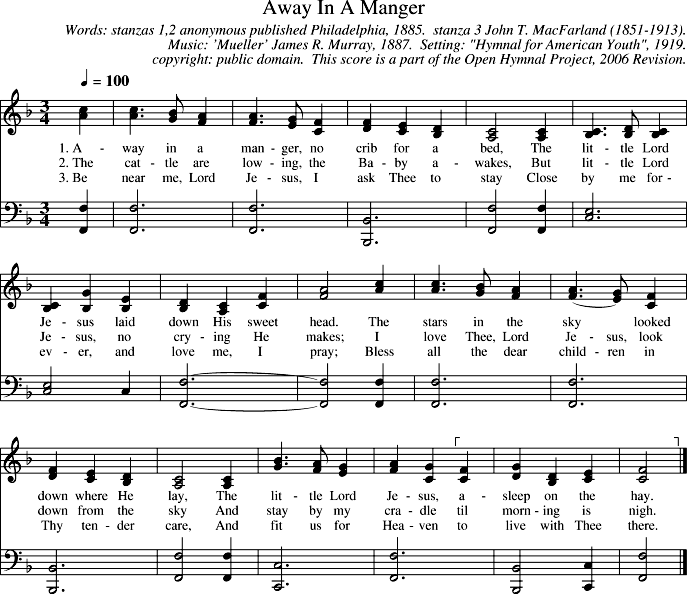
Away in a Manger


THE CATTLE ARE LOWING, the Baby awakes. But little Lord Jesus no crying He makes. Wait a second! That line in the second verse of the beloved carol, “Away in a Manger,” has irked me for years. Of course, it has not been enough to stop me from singing it at Christmas Eve services or at times of caroling around the piano or even at bedtimes with the children (during, potentially, any month of the year, not just December!). But the pebble of irritation about the manger scene has proven to be just enough to re-open the Christmas narrative and see if such a detail is explicitly mentioned or implicitly inferred anywhere. Did little Lord Jesus, really, no crying make?

Verdict—Mary’s first delivery was a normal, healthy delivery in every way, which leads me to conclude that there must have been plenty of crying to go around! Jesus, Mary, Joseph, shepherds, and eventually the wise men—pass the Kleenex® box around. Can angels cry? Well, if they can they too might have joyfully blubbered with the rest of them! “I bring you good news of great joy which will be for all the people” (Luke 2:10).

Not in 2011 … nor, for the record, in 2012(!) … but Shellie and I have made our rounds through the obstetrics ward at the hospital five wonderful times in the last 14¾ years. We have concurred that it would not be in the least bit serene, or happy, or joyful to have a baby who was not crying in the first moments of life. There is nothing in the Christmas account in Scripture that even remotely suggests that Mary’s delivery was any different than any other woman’s delivery or that Jesus’ birth was anything different than any other baby’s birth. Certainly, Mary and Jesus were unique in ways that beg for more study and more dialogue, but the events of that night were entirely … and dare I say … blessedly ordinary.

I am not trying to spar with poetic license written into “Away in a Manger.” Actually and tangentially, I found something else noteworthy in the relatively few verses allotted to Jesus’ birth in the Bible; something that I might have missed if it were not for my borderline compulsive urge to fact-check traditional Christmas carols. This year I noticed an amazing absence of anything out of the ordinary with Jesus’ actual birthday. His birth infused blessing into uneventfulness.

Perhaps you are like us in this regard, too often we give thanks for the brushes with the supernatural; those macro- or micro-deliverances that could only be explained after-the-fact by a providentially attentive Almighty God who graciously scrutinizes our paths. But I don’t know if I have ever before thought of the blessing of the ordinary. Granted, on that first Christmas there are many elements of sheer drama and utter terror, where the so-called experts were tongue-tied and the so-called bumpkins were silver-tongued. We would be the last to remove, even remotely, the supernatural from the Incarnation. But on that night, with that couple, in that stall, with that feeding trough nothing extraordinary happened. On the nearby hillside where the shepherds were guarding their flocks at night, there were supernatural fireworks going off. In the far-away sand where the Magi were studying the night-sky, there were miraculous “dots” being connected. But in the stable behind the inn which had no room for the King-in-disguise there was the blessing of uneventfulness.

Mary, for sure, had unanesthetized labor-pains throughout her delivery. Joseph, for sure, wished there was someone else present who had actually delivered a baby before; or at least someone who could advise him about basic female anatomy since he and Mary had not seen each other in that way yet. Not to belabor the point (pun intended!), but there was blood and fluid and after-birth and the ubiquitous clumsiness of figuring out how to feed a baby as a first-time mom. And, in my imagination, crying must have been generously exercised—before, during, and after the birth.

For Mary and Joseph all the miracles—and there were many—happened before and then after this very ordinary birth. The conception, of course, was perhaps the greatest miracle of all. The marriage that was not severed when Joseph discovered the news of Mary’s pregnancy without his (or any male’s) participation—this was a miracle that must not slip past our careful attention. Mary’s miraculous welcome received from her relative, Elizabeth, who was also miraculously pregnant. Jesus’ fantastic in utero greeting from his in utero cousin, John (the Baptist), was also miraculous. Time prevents a full treatment of the miracles that light up the narrative: the shepherds, the angels, the Christmas Star that apparently moved as needed to guide the wise men to Jesus, the escape from the massacre at Bethlehem, the dreams given to Joseph several times along the way, the name selected for the Savior, the city where the birth took place, even the timing of the tax requirement issued by Quirinius the Roman governor of Palestine at the time.

But that night, away in a manger, God steeped sublime dignity into the ordinary by allowing His Son to be birthed in exactly the same way all humans are birthed. God infused supernatural guidance and perseverance—incognito—into the otherwise uneventfulness of Christmas. This is the Christmas meditation that I stumbled across while looking for another thing altogether—what so often feels like God’s distance when it takes our every ounce of energy just to keep “treading water” in the ordinary, just trying to make it, just waiting for the time to punch out for the weekend … what often seems like God’s disinterest or even disapproval in our achingly long stretches of silence and uneventfulness … might actually be the times when God is nearest of all. God is not always found in the euphoria of the phenomenal, or in the serenity of the mystical. Sometimes—and arguably most times—God is found in the ordinary manger straw that is intentionally hidden in the alley behind the neon “no vacancy” sign, underneath the pain, awash with salty tears on the clumsy side of life when we think no one is paying any attention at all. Pass the Kleenex® box—for what seems to be the most ordinary may be, in fact, our front row seat for the most extraordinary thing of all: God came near.

Friday, December 2, 2011

Uganda 2011


Webele Yesu (WAY-buh-lay YAY-soo)—thank You, Jesus—for a very good, very deep, very rich 11 days to Uganda and back again.

Dr. David Livingstone—Scottish missionary to and explorer of the African interior during the mid-1800s—wrote many books and journals that our eyes have never skimmed. Conceivably his mind has forgotten more information than our minds have ever learned. Certainly his feet have gone places our feet have never dared to go—that is until last week. For an unforgettable week Shellie and I were in places nestled between Lake Victoria and Lake Albert in the Rwenzori Mountains of western Uganda; places that might very well have hosted Dr. Livingstone we presume(!) as he hunted for the sources of the Nile … places that help us to understand a fraction more of what Livingstone once said, “If you have men who will only come if they know there is a good road, I don't want them. I want men who will come if there is no road at all.”

Last week we saw where the “good road” quite abruptly ends and where, beyond the asphalt, rose the “smoke of a thousand villages” as Dr. Robert Moffat said to young Livingstone, thus propelling him deeper into the African interior than any missionary before him (William Garden Blaikie, The Personal Life of David Livingstone, 1880). Last week we tasted the other-worldly lure of contributing to the spread of the gospel of Jesus Christ to all nations through the agency of the local church. Last week we thanked the Lord for the honor to travel several hours beyond the spot where the “good road” ends for the purpose of speaking the promises of grace in at least one of those “thousand villages”—Nyahuka village in Bundibugyo district, Uganda, just a few kilometers from the Congo border.

It was a week of “firsts”: our first trip to Africa, to Uganda, to the Equator where the water doesn’t swirl when flushed (when there was water!). This week brought the first glimpses of banana, mango, and cocoa trees; the first fields of coffee bushes and tea plants. We trekked into the rainforest to see a community of chimpanzees, drove on the left-hand side of the road through mud as deep as the 4x4 tires were tall—these were all “firsts” for us. Never before had we forded a swiftly running river in a vehicle or eaten the parts of a chicken we normally toss to the dogs. Never before had we gotten sunburned in November. These were our first tastes of goat, posho, millet, and matooke. We have never before been awakened at 5:30am by Arabic-speaking Muslims over the loud speaker indiscriminately calling would-be converts in the village to wake up and stop being lazy (or so the translation was reported to us since we do not, nor does anyone in the village, speak Arabic) and come to prayer mandatory for their salvation. Subsequently, we have never before distinctly thanked God for His grace in that particular setting, as the loud speakers crackled in the pre-dawn darkness—thanking Him particularly that it is not what we do that saves us (like pray five times a day) but what Christ did—serenely rolling over to sleep for another hour in our freedom in Christ before the sun blazed through the screened window. It was a week of “firsts”; even spelling them out makes me think of more “firsts” to round out our journey story.

We have seen grasshoppers before, of course, but never had we seen crowds gather where men turned on bright lights at dusk in order to attract the insects, catch them in nets, and sell them wriggling in the bag for future feasting. We have experienced cold showers before, of course, but never because there were no hot water heaters at all and certainly not during a typhoid outbreak in the local water sources. I have keynoted at conferences before, but never before had I taught 21 pastors across 3 denominations for 8 consecutive hours about disciple-making through the gospel of Matthew…and never before had I taught a second time in one week with 12 missionaries from 3 countries about the “glory” of Christ. Shellie had visited medical clinics before, but never before when latex gloves were luxury items and never before when malnourishment was so rampant (even in a place where everything seems to grow; but too little protein).

We have participated in prayer services before, thousands of them probably, but never before had we prayed for and with people who were dying of HIV/AIDS. We have joined in praise services before, but never before to our ears had the songs been offered to Jesus in the beautiful Lubwisi language; never before had the instrumentation been solely homemade drums and voices woven together in distinctly non-Western harmonies. We have gone on pastoral visitation before, no doubt, but never before has it been on foot down trails far too narrow for vehicles through clusters of banana trees, mud houses, and very thin children practicing their one memorized English greeting, “How are you?” We must have replied, “Fine, how are you?” a thousand times. [How did they know we spoke English; two of probably six mzungu (foreigners) residents in their whole district all of whom form the World Harvest Mission Team of missionaries and who are consistently, visibly sunburned—almost glowing—whether they are seen at the village market or in the health clinic or at the water project or around the church?]

Webele Yesu—thank You, Jesus—for such a deeply moving, textured, and soul-altering week with the Babwisi people. May they be well-represented when all the tribes and tongues and peoples sing Your praise at that great Ingathering of worshipers when You return to earth as King of the nations.

Webele Yesu—for our friends, new and old, serving with World Harvest Mission in Bundibugyo, Uganda, East Africa for the sake of Your name. May they be sustained and empowered on all levels and in all ways by the Spirit, especially in those non-glamorous parts and storylines that never make it into the prayer letters or the mission conferences.

Webele Yesu—for allowing Shellie and I to make this trip together, for allowing our children to be well-loved and “super-cared-for” by Grandma and Grandpa, for allowing our church in Siloam Springs, Arkansas to be ultra-supportive and generous to “lease us out” to minister to the larger Body of Christ (which is not often the case!).

Webele Yesu—for each of you; some who prayed, some who gave money, some who donated supplies, some who filled the pulpit, some who administered the communion, some of you who did a combination of all of these gifts. This trip was simply impossible without your participation.

Webele Yesu—for the gospel of Your grace that changed our hearts from merely focusing upon ourselves to focusing upon the nations, even if only for 11 days at a time.

Webele Yesu—for the upcoming opportunity, July 4-24, 2012, to return to Uganda with a team from our local church (a team which this time includes our son, Seth, who will be 15-years old and excited to join the “adult” ranks in missions!) to serve and assist Your servant-missionaries who are living among and ministering to the most vulnerable in eastern Uganda. May Your name be glorified now and then and beyond then.

For the sake of the Name (3 John 7),

Kevin & Shellie Rees

2 December 2011

“God, send me anywhere, only go with me. Lay any burden on me, only sustain me. And sever any tie in my heart except the tie that binds my heart to Yours.” — David Livingstone